

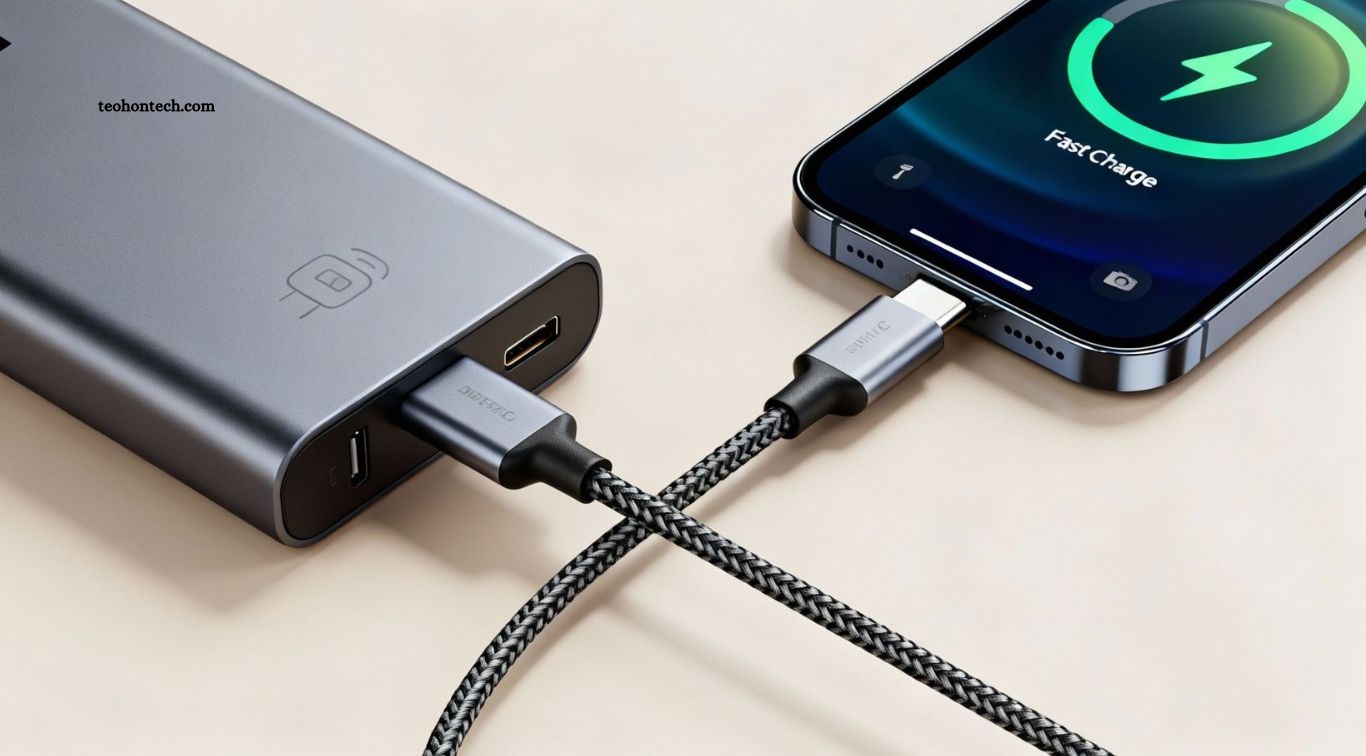
A good power bank for fast-charging phones should deliver reliable charging speeds, sufficient battery capacity, strong safety features, and compatibility with your device. Modern smartphones support different charging technologies, so choosing a power bank involves more than checking its capacity or advertised wattage. The right model can recharge your phone quickly, provide extra power during travel, and reduce the need to carry multiple charging accessories.
Before buying a power bank, consider its output power, USB-C connectivity, charging protocols, capacity, portability, and overall build quality. A power bank with high wattage may not deliver its maximum speed to every phone because charging depends on device compatibility. Understanding these features helps you select a dependable option that matches your phone, daily routine, and budget.
Read More: Best Laptops for Multitasking, Editing, and Everyday Work
What Is a Fast-Charging Power Bank?
A fast-charging power bank is a portable battery designed to recharge compatible devices faster than conventional low-power chargers. It supplies power through USB ports, commonly USB-C, using supported charging standards. Depending on the phone and power bank, fast charging can significantly reduce charging time compared with basic 5W or 10W charging accessories.
However, fast charging depends on several components working together. Your phone must support the power bank’s charging protocol, the power bank must provide a compatible output, and the cable must handle the required power. If any component limits the connection, charging may be slower than expected. Checking all three before purchasing helps avoid paying extra for speed your phone cannot use.
Choose the Right Wattage for Your Phone
Wattage is one of the most important specifications when choosing a fast-charging power bank. It indicates the maximum power the device can deliver under supported conditions. Many everyday smartphones work well with 18W to 30W charging, while some newer phones support higher charging rates. The ideal output depends on your phone’s maximum supported input and its charging technology.
Buying a power bank with a higher wattage rating does not automatically make your phone charge faster. The phone controls how much power it accepts, and charging speed often decreases as the battery fills or the device becomes warm. Check your manufacturer’s specifications before choosing an output rating. A compatible 30W model may be a better value for one phone, while another device may benefit from a supported higher-power option.
Look for USB-C Power Delivery Support
USB-C Power Delivery (USB PD) is a widely used fast-charging standard that allows compatible devices and chargers to negotiate suitable power levels. A power bank with USB-C PD can support fast charging for many modern smartphones, tablets, and other electronics. This makes it a practical choice for people who want one portable charger for several devices.
Still, USB-C describes the connector, not a guarantee of a particular charging speed. Some power banks have USB-C ports with different input and output capabilities, while phones may require specific charging protocols for their highest speeds. Read the technical specifications carefully and confirm that the port supports the output your device needs. A suitable USB-C cable is also essential for reliable performance.
Understand Your Phone’s Charging Technology
Different smartphone manufacturers use different charging systems. Some devices rely on USB Power Delivery or its Programmable Power Supply feature, while others use proprietary technologies designed for higher charging speeds. A power bank that supports one standard may charge a particular phone quickly without reaching the maximum speed advertised by the phone manufacturer.
Before buying, identify your phone’s supported charging protocol and maximum wired charging rate. Compare these details with the power bank’s listed output profiles and compatibility information. If your phone uses a proprietary fast-charging system, look for a power bank explicitly confirmed to support it. Otherwise, a compatible USB PD power bank may still charge your phone efficiently, although it might not match the manufacturer’s peak charging speed.
Select the Right Battery Capacity
Capacity determines how much energy a power bank can store. It is usually advertised in milliamp-hours (mAh), with common options including 5,000mAh, 10,000mAh, and 20,000mAh. A 5,000mAh model is generally suitable for emergency top-ups, while a 10,000mAh power bank offers a balance between portability and extra battery life for daily use.
A 20,000mAh power bank can provide more charging capacity for long trips or multiple devices, but it is usually heavier and larger. Actual charging performance also depends on voltage conversion, energy losses, cable efficiency, and your phone’s battery size. Therefore, a 10,000mAh power bank will not necessarily deliver a full 10,000mAh to your phone. Choose capacity based on how often you need to recharge and how much weight you are willing to carry.
Check Charging Speed for Multiple Devices
Some power banks can charge two or more devices simultaneously through multiple USB ports. This feature is useful when carrying a smartphone, wireless earbuds, smartwatch, or tablet. However, the total output may be shared across connected devices, meaning each device may receive less power when multiple ports are in use.
Check both the maximum output of each port and the total combined output. For example, a power bank advertised with a high maximum wattage may provide that level only when one device is connected. When several devices are charging, power distribution can change. If you regularly charge multiple gadgets, choose a model with a clearly documented power-sharing system and enough total output for your needs.
Consider Pass-Through Charging and Recharging Speed
A power bank’s own charging speed is also important. A high-capacity model can take several hours to recharge if its input power is limited. Look for a power bank that supports suitable USB-C input wattage and, where available, a clear estimate of its recharge time. Fast input charging is especially useful for people who frequently travel or use their power bank every day.
Some models offer pass-through charging, allowing the power bank to charge a connected device while it is being recharged itself. This can be convenient, but the feature is not available or recommended on every model, and it may create additional heat. Check the manufacturer’s guidance before using it regularly. For everyday reliability, prioritize safe charging behavior and suitable temperature management over extra features you rarely need.
Prioritize Safety and Temperature Control
Safety features are essential because power banks contain rechargeable lithium-based batteries. A quality model should include appropriate protection against overcurrent, overvoltage, short circuits, and overheating. Reputable manufacturers also provide clear product specifications, warranty information, and guidance for safe use. Reliable construction is particularly important when carrying a power bank in a bag or using it frequently.
Heat can affect charging speed, battery health, and overall safety. Fast charging naturally generates some heat, but excessive warmth should not be ignored. Choose products from trustworthy brands and avoid damaged, swollen, or suspiciously cheap power banks with unclear specifications. Stop using a power bank if it develops an unusual smell, visible damage, swelling, or excessive heat. Do not leave it exposed to direct sunlight or extreme temperatures.
Choose a Portable Design for Everyday Use
A power bank should fit comfortably into your daily routine. Compact 5,000mAh models are easy to carry in a pocket, while 10,000mAh options often provide a practical balance between size and capacity. Larger 20,000mAh models are better suited to extended travel, long workdays, or situations where access to a wall outlet is limited.
Consider weight, dimensions, cable requirements, and port placement before purchasing. Built-in cables can reduce clutter, while a clear battery indicator helps you estimate remaining power. Some models include digital displays that show battery percentage or charging output. These extras can be helpful, but prioritize charging compatibility, safety, and reliable performance before choosing a design based on appearance alone.
Compare Build Quality, Warranty, and Price
A good power bank should offer dependable performance over time rather than simply impressive specifications on the box. Look for sturdy construction, well-fitted ports, clear labeling, and a warranty supported by the manufacturer or authorized seller. Independent reviews can help you assess real-world charging performance, heat management, and durability, especially when reviewers test the power bank with compatible devices.
Price should be considered alongside capacity, output, safety protections, and warranty coverage. A very cheap power bank may advertise high capacity or wattage without providing enough reliable evidence to support those claims. Compare products with similar specifications and purchase from reputable retailers. Spending a little more on a well-documented model may provide better long-term value than choosing the cheapest available option.
Frequently Asked Questions
What wattage is best for a fast-charging power bank?
For many modern phones, 20W to 30W is a useful starting point, but check your phone’s supported charging rate.
Is a 10,000mAh power bank enough for daily use?
Yes. It often provides a practical balance between portability and extra battery capacity for everyday charging.
Does a higher-wattage power bank charge every phone faster?
No. Charging speed depends on the phone’s supported wattage, charging protocol, cable, and temperature.
Is USB-C better for fast charging?
USB-C is a convenient modern connector, but fast charging also requires compatible power delivery and charging protocols.
How long does a power bank last?
Its lifespan depends on battery quality, usage, charging habits, temperature, and how frequently it is cycled.
Can I use my phone while it charges from a power bank?
Yes. However, intensive activities can generate heat and increase power consumption, potentially slowing battery charging.
Conclusion
A good power bank for fast-charging phones combines compatible wattage, suitable battery capacity, reliable USB-C connectivity, strong safety protections, and durable construction. Before purchasing, check your phone’s charging requirements, confirm the supported protocols, and choose a capacity that suits your daily routine or travel needs. Do not rely on advertised wattage or mAh alone. By comparing real specifications and buying from a reputable brand, you can find a power bank that delivers convenient, dependable charging wherever you go.

1 Comment
Pingback: Best Monitors for Remote Work, Gaming and Creative Projects - TeohOnTech